Digger is a Masterfully Bleak Criticism of Society's Response to Climate Change
Lots of SPOILERS follow, including ones that are fundamental to experiencing the film fresh. If you're interested in climate change, I strongly urge you to avoid reading anything else about the film until you see it.
I worked in climate policy and science communication for about 20 years. I went into Digger knowing barely anything about it and was blown away by the film's incredible meta-commentary about how audiences respond to depictions of climate change as well as where those depictions come from.
Alejandro G. Iñárritu's vision is searing and bleak and this review will focus mostly on how it functions at a broad, societal level, but it is also visually stunning and features powerful performances from Tom Cruise, John Goodman, Riz Ahmed, Jesse Plemons and many others. If you enjoy dark satires, which I do, it is also very funny.
Two Twists
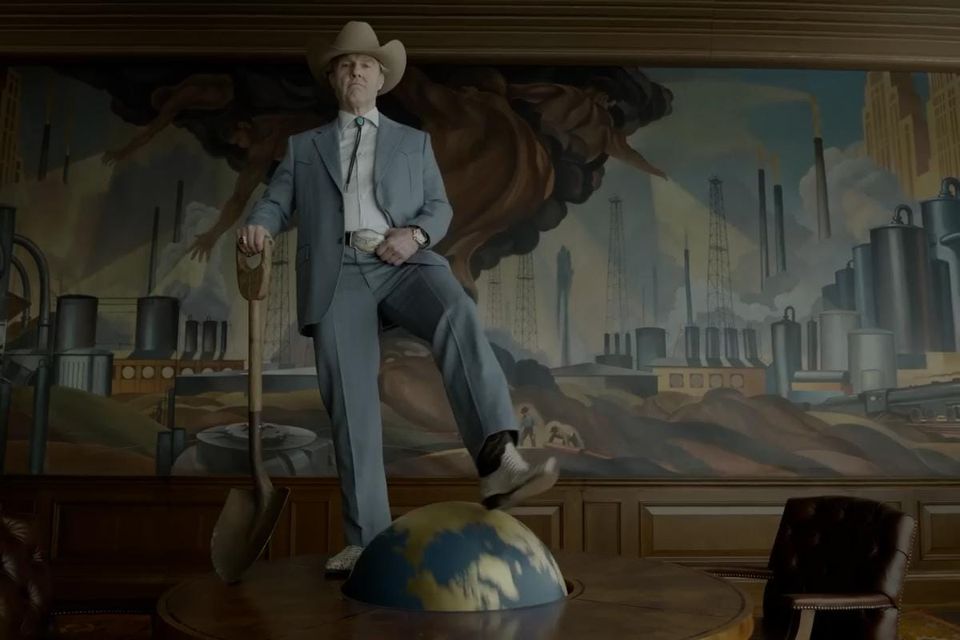
The film opens as an over-the-top nearly cartoon depiction of a wealthy oil magnate ignoring warnings that a drilling operation is about to catastrophically fail in Greenland. But midway through the film's first act, a prop fails and the audience sees that they are actually watching a rehearsal of a play and the play is the over-the-top satire. We can now see the film on another level, as an expression of how the film's world fictionalizes climate change.
Suddenly, the otherworldliness of the sets, the strange placement of doors and occasional leaking pipe begin to make sense. We are watching a stage production. Iñárritu gives us glimpses of the outside world as stage actor Curtis Markson (Cruise) tries to figure out if his daughter is on a flight that could be in the path of a remarkably intense hurricane. He flits through projected video calls and script rewrites on his backstage dressing room mirror, letting us know we are looking at a future world where this display technology is commonplace and climate change has indeed progressed apace.
Much later in the film, we learn that the stage production's benefactor is none other than Kenny Rockwell (Plemons), the real-life nephew of "Digger" Rockwell. As he intervenes to prevent the production from being derailed we learn that some version of the satirical events being depicted actually happened in this world – a chunk of Greenland glacier really bombarded Northern Europe and Digger was a real person who was responsible for mass death from oil exploitation. Rockwell says he was moved by the play – called Fossil Fools – as a young man and bought the rights in the hopes of staging it again as a means of bringing people together. He reveals to the audience through this bit of exposition that the theater they are in was refurbished just for this play and that people in the outside world rarely gather for plays. Things are bleak out there.
In the film's denouement, a rapturous audience cheers when Digger, in exile on an oil platform, leaps to his death. Backstage, Rockwell helps Markson confirm his daughter is fine. The actors soak in an ovation. But an alarm sounds. "Level 4" a voice intones. The audience dons high-tech filter masks and disgorges into a gray NYC street scene. (A small street sign refers to Albany Street, a real-life street near Battery Park, an area vulnerable to sea-level rise.) There's anti-oil graffiti on walls, troops and military robots on the street, and heavy military equipment rolling through floodwater.
Levels of Complicity
In the stage show, Digger defends himself in front of a European parliamentary body, largely by saying he was extracting oil to give people what they want. The parliamentarians are gray and bland, and some stand awkwardly under too-low ceilings, suggesting the limits of their own power over an oil magnate. In desperation, one of them nails Digger with a shoe. But his point is made. Wall Street loves his speech. Digger uses many tropes today's fossil fuel boosters use, including accusing the parliamentarians of hypocritically flying to meetings and vacations.
Back in the film's "real" world, Markson's own daughter is flying somewhere from Jamaica, a fossil fuel indulgence that seemingly still persists in a climate-ravaged world. "Rockwell" meanwhile is a not unsubtle reference to the Rockefeller family, parts of which have used money that derives from the vast Standard Oil empire to fund arts and environmental stewardship. Is Kenny Rockwell doing good by putting on this play? He refers to it as a means of catharsis. The audience cheering when his uncle dies has meaning for him. But the stage production will not change anything – it is an outlet for the deep feelings of bitterness people have toward a generation of powerful oligarchs who ruined the climate.
In this scene, Iñárritu is letting us know that this movie won't change anything either. It is also catharsis, but for a future world yet to be realized. Kenny Rockwell is telling us the truth, just as the jittery and eventually desperately drunk scientist in the play (Ahmed) is telling the truth about breakaway glaciers. Here the film does not have the Hollywood-matters pretense of Don't Look Up, which well satirized science communication and policymaking, but which mass audiences often failed to understand as a climate metaphor. But still, it's asking us if we are really listening to the truth.
Kenny Rockwell, like other wealthy people, is retaining a shadow of his uncle's influence even in the world he helped ravage. He runs an intelligence company, which is able to easily locate Markson's daughter. At one point, Markson wonders if he is portraying Digger correctly. Was he a farcical man, really? But Rockwell assures him that it is Markson's "constant disappointment" that reminds him of his uncle. So Rockwell is paying a famous actor to humanize his criminal uncle. The mutual complicity – compounded by class solidarity – is complete.
The film's ending also implies that the audience for the stage production are themselves relatively well off New Yorkers, all of whom have high-tech filtered masks with light-up indicators. The play's stage production is top-notch, after all, maybe like old Broadway that people haven't seen in years. Meanwhile, a member of the underclass is seen fishing trash out of NYC's canal-like streets. The graffiti on the wall suggests a more militant part of the underclass that is heavily policed by the state.
Exiting our own theaters, Iñárritu invites us to wonder if what we watched really mattered, too. Or is it the still-blue skies we see, the world yet to die, and the evil men like Digger who rule us now that should command our attention?